On our first photographic trip, we asked our mentor what she considered the most difficult wildlife to photograph. Without hesitation, she replied, “Bird photography!” We were immediately drawn to that challenge and its hold on us has never loosened. Many photographers have an experience with an animal that inspires the trajectory of their photographic journey. In our case, the inspirational creatures were birds - a Northern Flicker and a Trumpeter Swan. The behaviors we are privileged to observe through our cameras are fascinating, dramatic at times and always informative. The majesty of the Bald Eagle, the ungainly beauty of the Roseate Spoonbill, the sheer pluck of a Water Ouzel (aka, American Dipper) surviving a Yellowstone winter….each attracts us…and we’d rather learn a lot about a species in depth by documenting behaviors than to simply record a pretty pose, though pretty poses have their place as you will see.
Birds of Prey
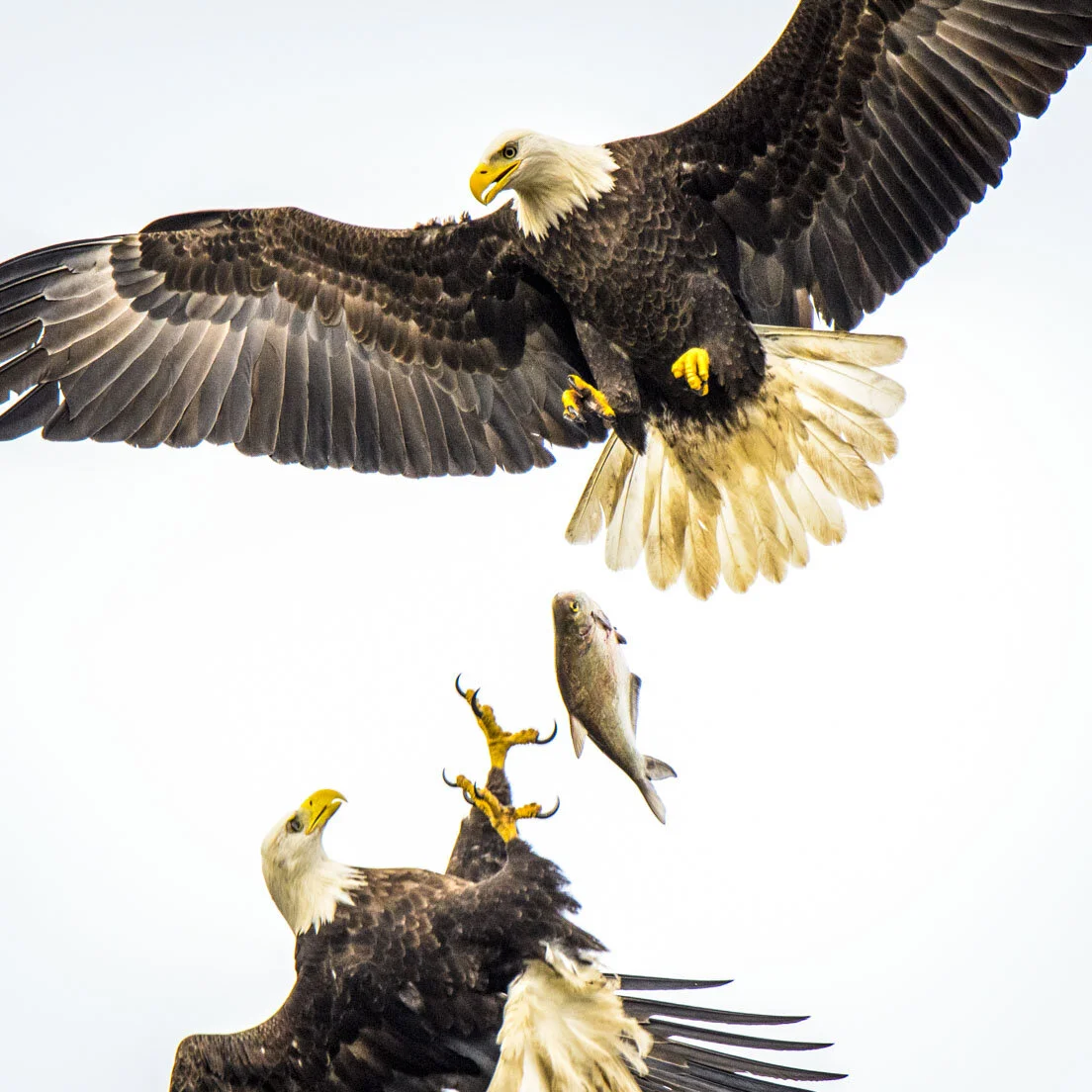
Bald Eagles are notorious opportunists. Fights among foraging eagles break out frequently and many fish are eaten by those who didn’t catch them. The Conowingo Dam in Northern Maryland is a site where well over a hundred Bald Eagles reside and fight over the fish that come through the dam.

This is the only raptor that regularly and characteristically hunts with other Harris Hawks as a team. As a result, they are easily trained to hunt for falconers. Found in the Southwest US and Mexico, this hawk was imported to Scotland to be part of a falconry program.

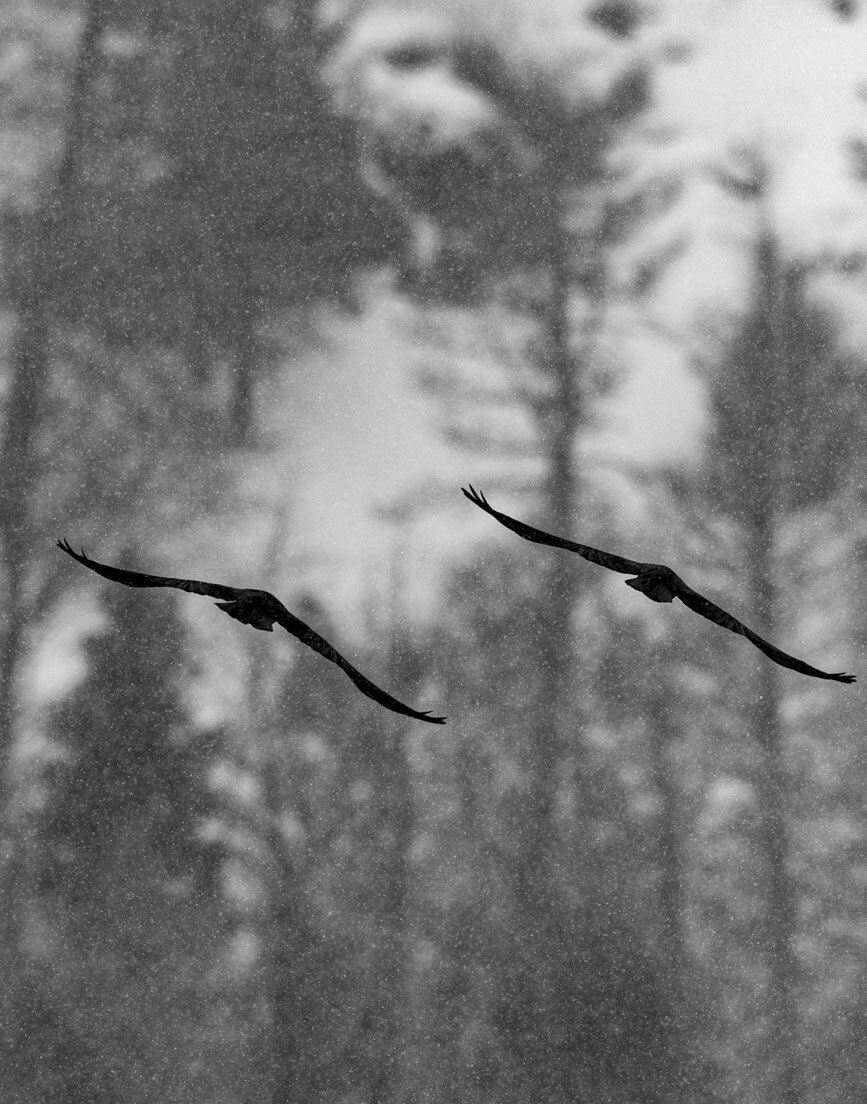
On one of our early winter trips to Yellowstone, our guide stopped the snowcoach and we quietly gathered our gear and hiked back to the area where this pair had been spotted. In this image we chose a light vignette to draw the eye from the branch filled background to further highlight the pair.

In the summer of 2018, on our annual trip with our grandchildren to Family Camp at Hog Island Audubon in Maine, we were privileged to see this eagle try to snatch the fish from the Osprey which had caught it. The eagle was faster but the Osprey more maneuverable and could make tighter turns, as here. In this case, the Osprey got away with its catch.

The Photo Ark is a project of Joel Sartore for NatGeo in which his goal is a portrait of all species in zoos/refuges around the globe. This Black Vulture, caught closeup near Conowingo Dam in MD, is similar in detail and mood to one of Sartore’s portraits, except that this was taken in the wild.

A pair of Cooper’s Hawks nested in a neighbor’s tree in 2016. Nest construction, egg laying, hatching, feeding of young, fledging, and initial hunting attempts by the fledglings were a source of amazement and wonder in our very urban neighborhood. Here one of the fledglings has a good look at us while flying past. The round profile of the bird is not something we have seen often, if at all.


Disturbance of nesting birds is an increasingly common ramification of the multiplying number of bird photographers and long lenses. Fortunately, these Great Horned Owls had not been widely “discovered” when a friend showed us this incredible sight. We stood behind a nearby tree to appear less visually apparent, but of course mother and child found us as fascinating as we found them.

We spend time each summer with our grandchildren at Audubon Family Camp at Hog Island ME. These two birth year siblings spent the whole week at 2019 camp, hunting, playing, and calling each other. This uncharacteristically quiet moment catches them just after a drenching downpour. They look a touch bedraggled but their spirit shines through as they study us while we study them.
Seabirds

Hovering Fulmar at cliffs of Hermaness, Shetland Islands. Know as a tubenose (as is the albatross), it is one of the longest-lived birds with a mean life span of 32 years. They nest on coastal cliffs and have learned to follow fishing boats to scavenge the catch, an adaptation to human activity which has resulted in increased numbers over the last 50 years.

These two fulmars strike an endearing pose while nesting among the sea pinks in Northern Scotland.
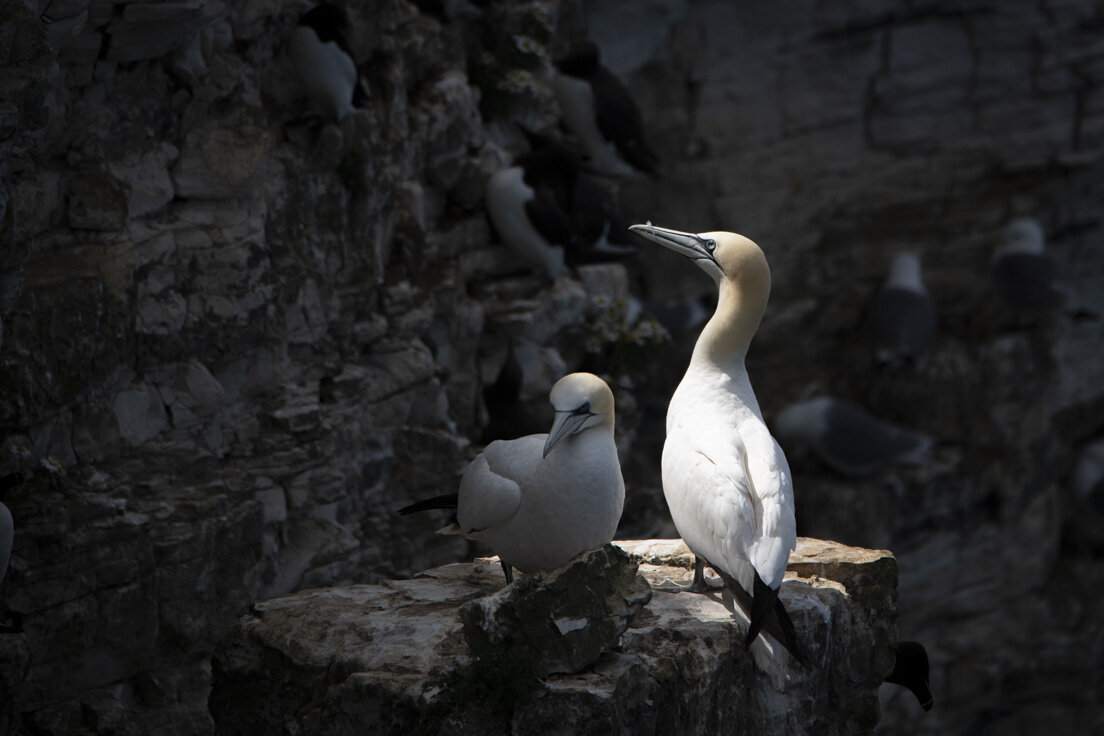
Beautifully lit by morning sun peaking around a cliff face, the male Northern Gannet is monogamous, mating for life. This huge bird with a wing span of about 6 feet can dive for fish as deep as 72 feet. Each parent takes his or her turn sitting on the eggs and chicks while the other hunts in the sea.

This lovely little fellow had just jumped off a cliff face on Mykines Island in the Faroe Island archipelago. During the late spring months the puffins return to their seasonal colonies from the sea to dig burrows in which to lay their eggs.
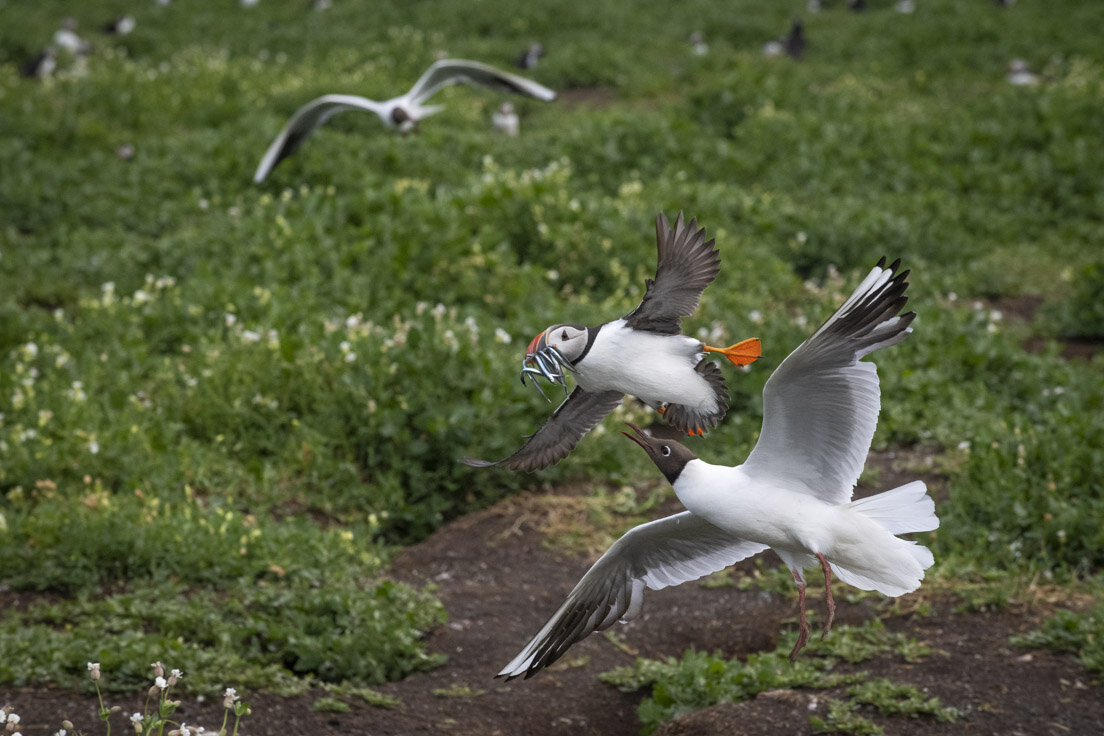
On the Farne Islands off the coast of northeast England there are breeding colonies of puffins. The black-headed gulls have discovered that there are opportunities to steal food from puffin parents bringing fish to their young. As a fish-laden puffin arrives on the island, the gulls put up a chase, mobbing the smaller bird and stealing its fish.

On Mykines Island, westernmost of the Faroes in the North Atlantic, puffins congregate for their breeding season. This one came quite close and began to preen its feathers among the grass of the cliff face. A shallow depth of field created the blurring of the foreground and background drawing the eye to the main subject.

The puffins on Sumburgh Head, Shetland Islands, Scotland, resting on the Sea Pinks (or Thrift) near their burrows. We were newly arrived off the ferry from Aberdeen and after a short drive this was our introduction to the Shetland Islands. The tufts of flowers provide a lovely spot to raise a family!

This image of a brown noddy pair could almost be a Black and White except for the subtle wash of brown color on the wings and bodies. It was taken from a heaving boat off the cliffs of Santiago Island, Galapagos in 2015. The overall moody gray color contrasts sharply with the eye detail and the obvious (we believe) affection between the pair.


A denizen of the Farne Islands off the coast of northeast England, this puffin sat patiently awaiting a break in activity near his burrow so that dinner could be delivered to a puffling.

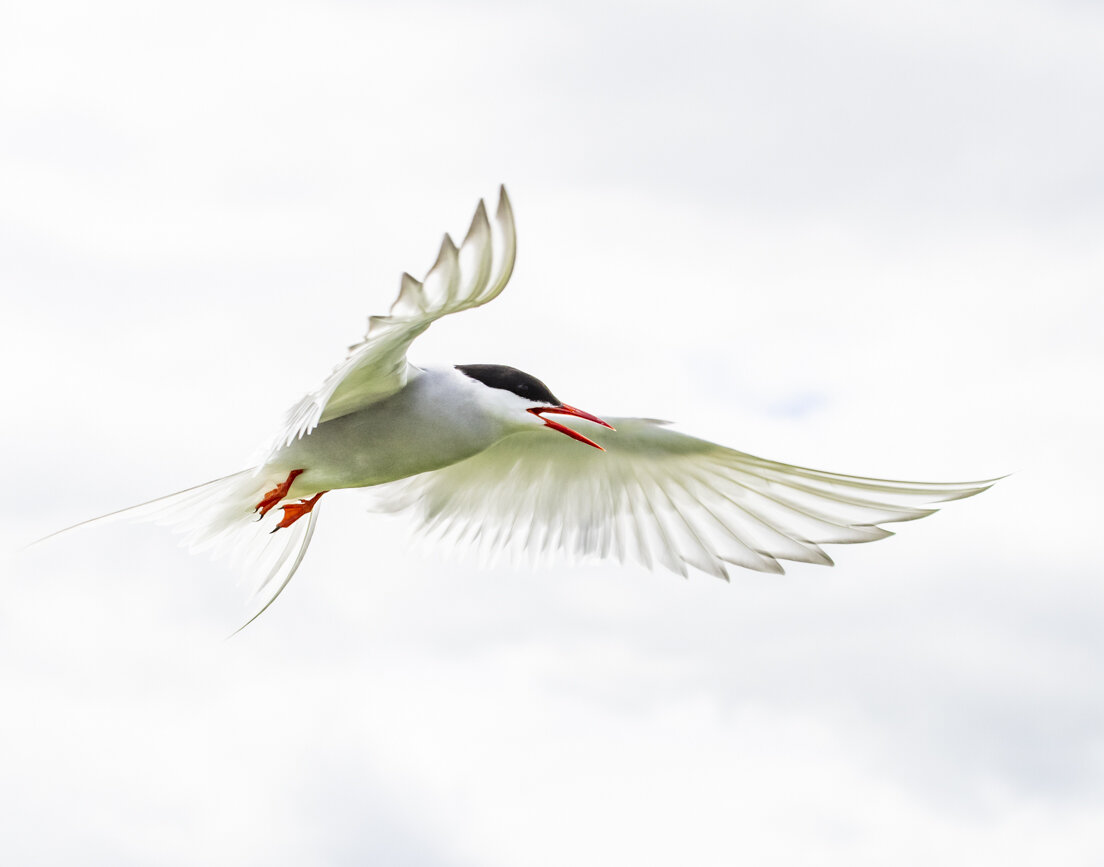


On a day when there were very few flying Bald Eagles at Conowingo Dam, MD, we were drawn to any other birds in the air. These two gulls made an interesting composition as one flew away and the other toward us.
Songbirds

This beautiful Black-throated Blue Warbler migrated from Central America to Magee Marsh, Ohio on his route to breeding grounds in the forests of Southern Canada.

The Magee Marsh is bejeweled with migrating warblers each spring. This is the northernmost of the range of the Blue-winged Warbler.

Another of the Magee Marsh spring denizens is the Palm Warbler. The day of this capture there was a strong wind which kept the birds down among the underbrush (rather than in their preferred treetops) affording lots of opportunities to the vigilant photographer.

On a visit to the Beidler Forest near Charleston, SC we came upon a pair of Prothnotary Warblers busy with their nest building. Given the need to make many trips to and from the nest cavity to the swamp floor to harvest nesting material we observed the patterns of flight and the types of materials being added. Bits of moss and small pine branches were included.

Stellar’s Jays live in the mountain forests of the Western US but will take advantage of a well-placed backyard feeding station as this one did in Cook City, WY. Boldly colored, they and the Blue Jay are the only crested jays in North America.
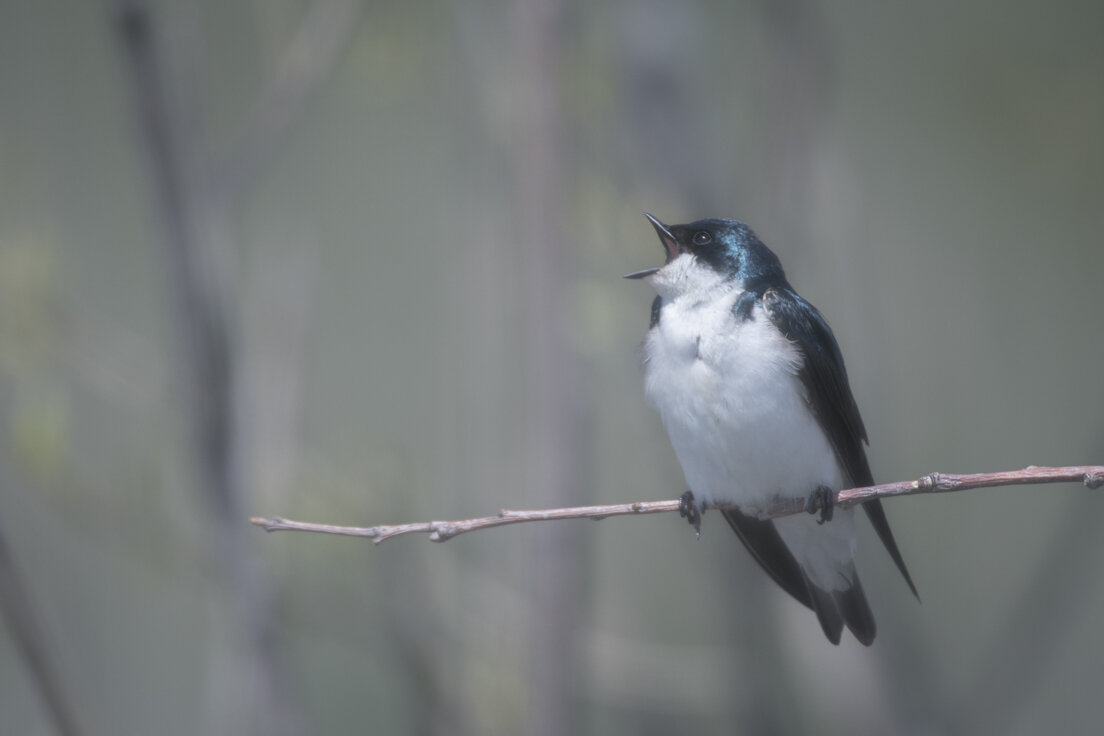
While driving through Ottawa NWR in northwest Ohio we happened upon this vocal little Tree Swallow. We often photograph from our car (our mobile blind) and, if we’re quiet and quick, can get an up close view. Open a car door and the bird vanishes!

Springtime at Magee Marsh Ohio is a great place to find warblers of all colors and patterns. Like many warblers they migrate from their winter homes in Central and northern South America to breeding grounds in central and northern North America. The male birds tend to be the songsters (defending their territory and calling to potential mates) in most bird species but there is a growing realization that female birds chime in, as well. For more follow this link: https://www.allaboutbirds.org/news/many-female-birds-sing-beautiful-songs-all-we-have-to-do-is-listen/

While visiting the Charles Darwin Research Station, Santa Cruz, Galapagos Islands a lumbering Galapagos Tortoise passed by with this tiny yellow hitchhiker. The impulse to take a quick photo was irresistible!

Boreal Chickadees live primarily in Canada with a slight dip in their habitation territory into northern Minnesota. They are to be found in coniferous forests of spruce and fir. To survive the cold northern winters they cache larvae and seeds and are often found at bird feeding stations when available. This little beauty was attracted by peanut butter that had been smeared on the branch a few feet away. The similar colors of bird and perch make this an eye-catching image.

We were with our guide deep within the boundaries of Beidler Audubon near Charleston SC when we saw this beautiful male Prothonotary with lots of bands on his legs. He and his mate (shown elsewhere on this site) were actively nest building in a hollow tree during our late April visit.

A visit to NW Ohio in early May is, from our perspective, not complete without a visit to Warbler Week at Magee Marsh.


Veerys live and breed in the dense understory of deciduous woods near water sources. Finding this Veery in just such a setting gives us a glimpse into where a Veery prefers to live. Their buff and brown plumage makes them hard to spot among the fallen leaves.
Shorebirds

Dunlins breed in Arctic Canada and Northernmost Alaska in the summer. Spring, fall and winter will find them along the Atlantic, Pacific and Gulf Coasts. These foraging shorebirds were photographed along the Gulf Coast of Florida.

Waiting patiently by a snag at Green Cay Wetlands, Boynton Beach, FL late in the afternoon and hopeful that a bird would grace us with its company, this Roseate Spoonbill in full breeding plumage landed somewhat awkwardly and this image was made as it was struggling for balance.
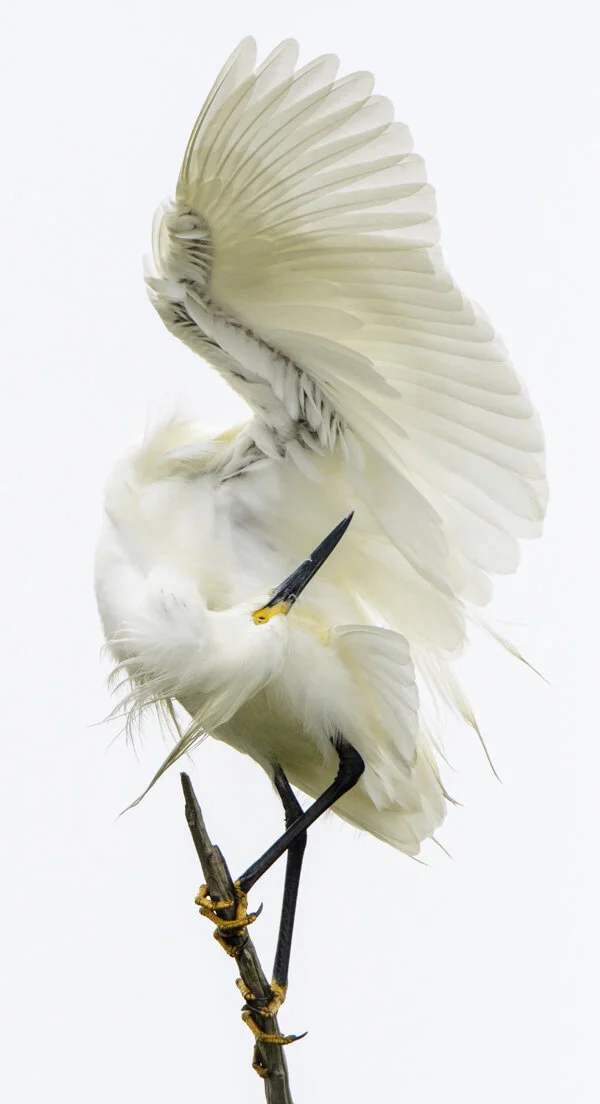
Ever since we were young Bombay Hook NWR has been a special place for family day trips on holiday weekends. On just such a trip on a gray day with few birds in the vicinity, this gorgeous Snowy Egret allowed us a close approach as it was preening on a snag. The intimacy of the moment, emphasized by curve, line and gesture, takes our breath away.

The Snowy Egret is one of our favorite birds to photograph. Its white plumage contrasts with many backgrounds and its habitats tend to be quite scenic. In this photograph in late afternoon light, the reeds along the riverbank provided a richly textured backdrop.

Another serene image of the Snowy Egret moving quietly through the still water. it is great fun to watch these waders search for small fish, worms, crustaceans and insects. To capture the lightning fast reflexes of these birds requires an extremely high shutter speed and good light.

A Willet foraging on the shore looks quite undistinguished - just another grayish bird among the other waders. But, when the Willet spreads its wings it becomes strikingly beautiful. Prior to the Migratory Bird Treaty Act of 1918, Willet numbers had declined shockingly due to hunting and egg harvesting. Since then, they have made a comeback but are still affected by human development and the loss of their habitat.

It was the end of a long day of shooting at Green Cay Wetlands (Boynton Beach, FL), the light was harsh, opportunities were few. This Anhinga, perhaps 10 feet off the boardwalk, was drying its feathers, an activity necessitated by the fact that it lacks the natural waterproofing oils of many waterfowl. Conversion to Black and White enhanced the detail and rendered the background a dark monochrome, further highlighting this magnificent bird.

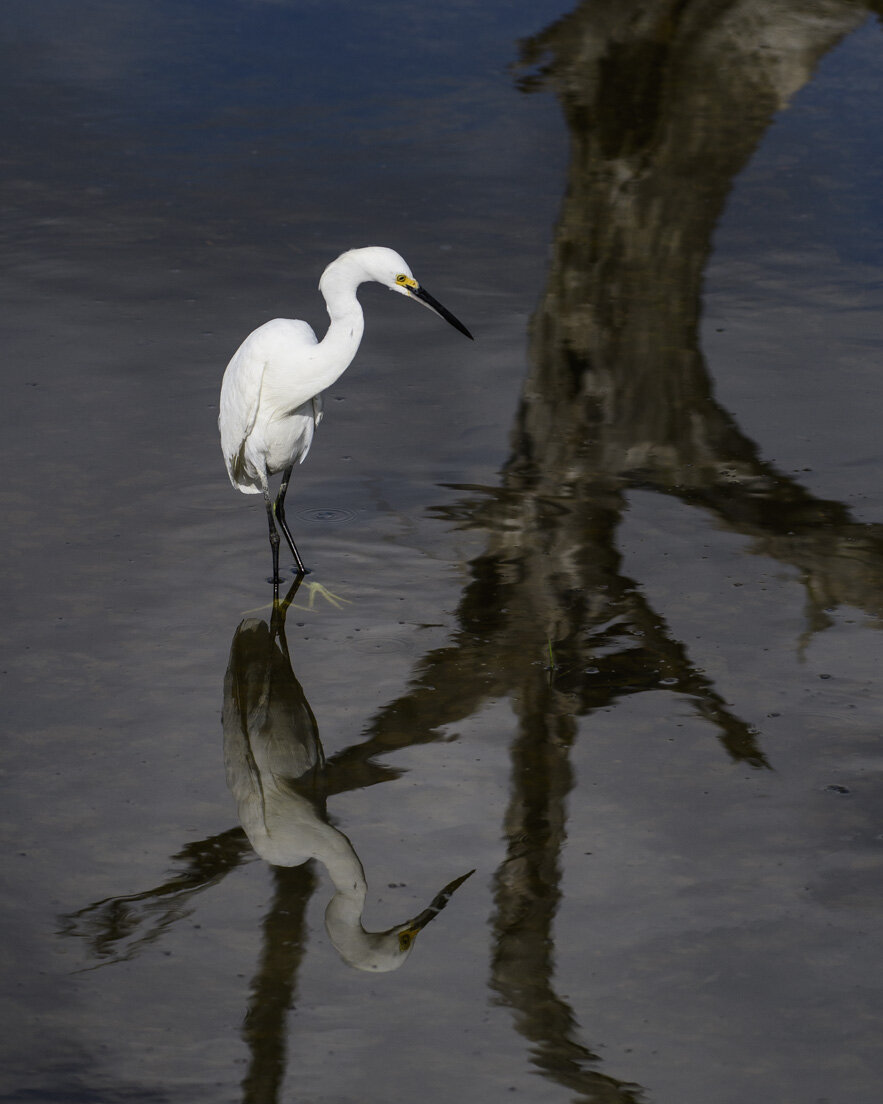
On a fall photography trip to the Eastern Shore of Virginia and Maryland, we spent several days on Chincoteague. The canal next to the Entrance Road is not very scenic, but the shoreline background here is in deep shadow, the reflection is nearly perfect, and the bird is beautifully side lit in the early morning. The moment of the successful hunt is a bonus!

While exploring Chincoteague NWR with our shooting buddies, we happened upon this Great Egret hunting in a canal in early morning side light. The jewel-like quality of the water droplets was, to our eyes, more attractive than the actual moment of strike. The reflective image sustains the image and provides symmetry.

This image, taken at the well known Great Egret rookery at Kiwanis Lake in York PA, is highly emotive to us. The bird’s feet and legs seem to emerge organically from the tree branch. Not a feather is out of place in the right wing. A single small twig is being delivered to the nest, seemingly almost in slow motion. It’s one of our earliest “art shots,” and still one of our favorites.


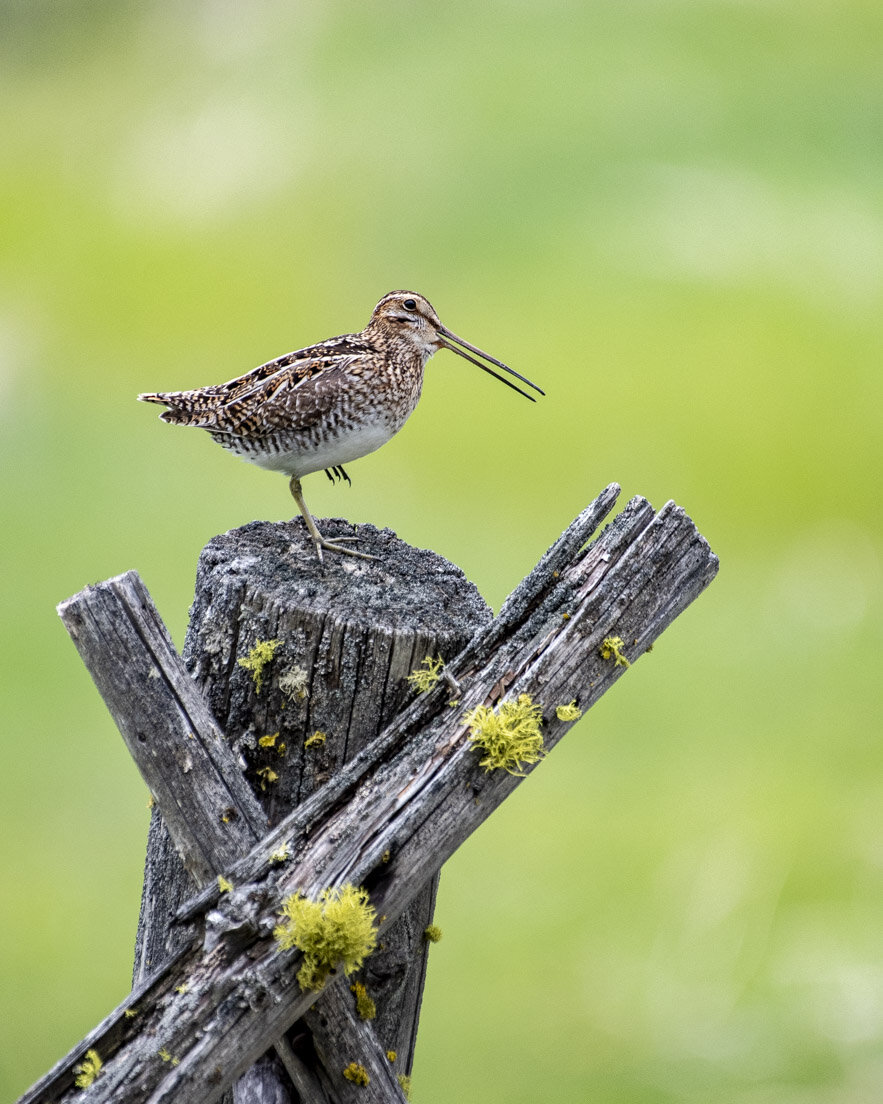


Flocks of American Avocets can be found along the Delaware coast in the fall, though this is not an area which appears as part of their migration range on the Cornell Lab of Ornithology maps. These birds are not in their breeding colors but make a lovely, graphic pattern in flight.

Birds can be found in some of the most surprising locations! At a manmade lake in York, PA in the springtime you can find a rookery (breeding colony) of Great Egrets.

Waterfowl

This goose family was photographed in Scotland in the spring of 2018. The beautiful green marsh grasses provide a complimentary background to the grays and muted tones of the Greylag. The Greylag breeds in England, Scotland and Iceland and migrates to Northern Africa.

While visiting friends in Duck NC in February 2018, we had a beautiful morning on the Bay Side, light behind us, when these Canada Geese suddenly, and loudly, launched nearby. The sunlight/shadow pattern through the nearby low buildings allowed us to catch one of the birds in warm morning sun while the others stay in deep shadow. Serendipity!


Miscellaneous

This handsome specimen was ‘caught’ on a beautiful branch in light which illuminates the blue of his/her feathers in Eastern Florida during the winter months of 2019. The Boat-tailed Grackle lives and breeds near fresh and salt water along the East and Gulf coasts of the US.
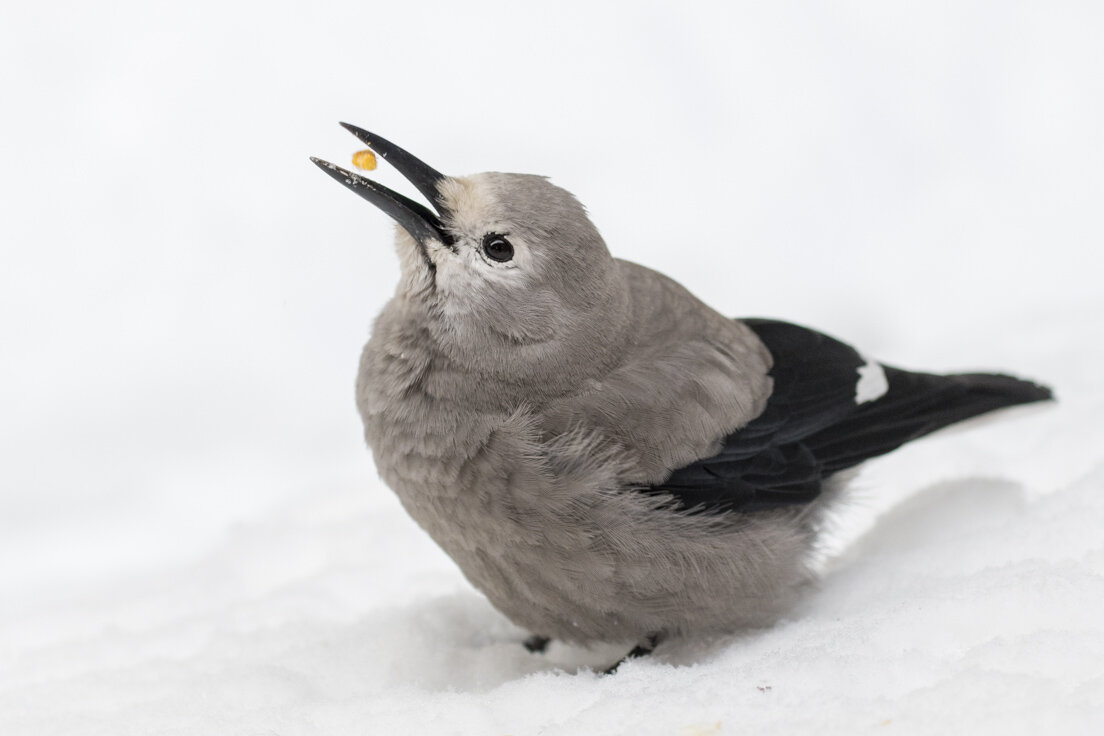
Clark’s Nutcracker is a bird of the Western mountains in the US. A member of the corvid family it lives in open, subalpine forests near the treeline. Though we don’t ordinarily shoot birds which have been '“baited, set up or called in”, in the interests of full disclosure, this bird had come to a backyard feeder just outside Yellowstone NP.
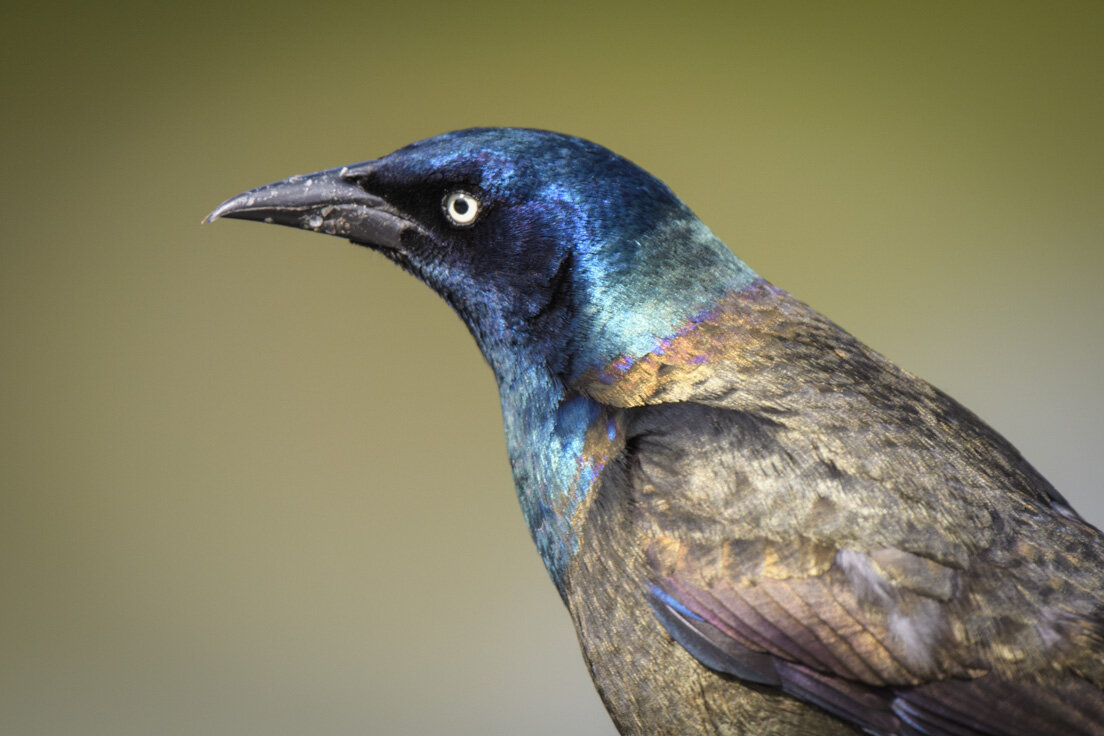
When light hits a bird’s feathers amazing colors can reveal irridescent hues in what might be considered an otherwise non-desrcipt black bird. Image taken in Southern Michigan.

One thread that runs through our work is the ability, afforded by large image sensors and long lenses, to create intimate portraits of individual birds in the wild. These speak to us, just like a human’s portrait in a studio, about this bird’s individual and unique nature and why we need to strive so hard to preserve them. This image was made near a feeder in Cooke City, MT, just outside Yellowstone NP.